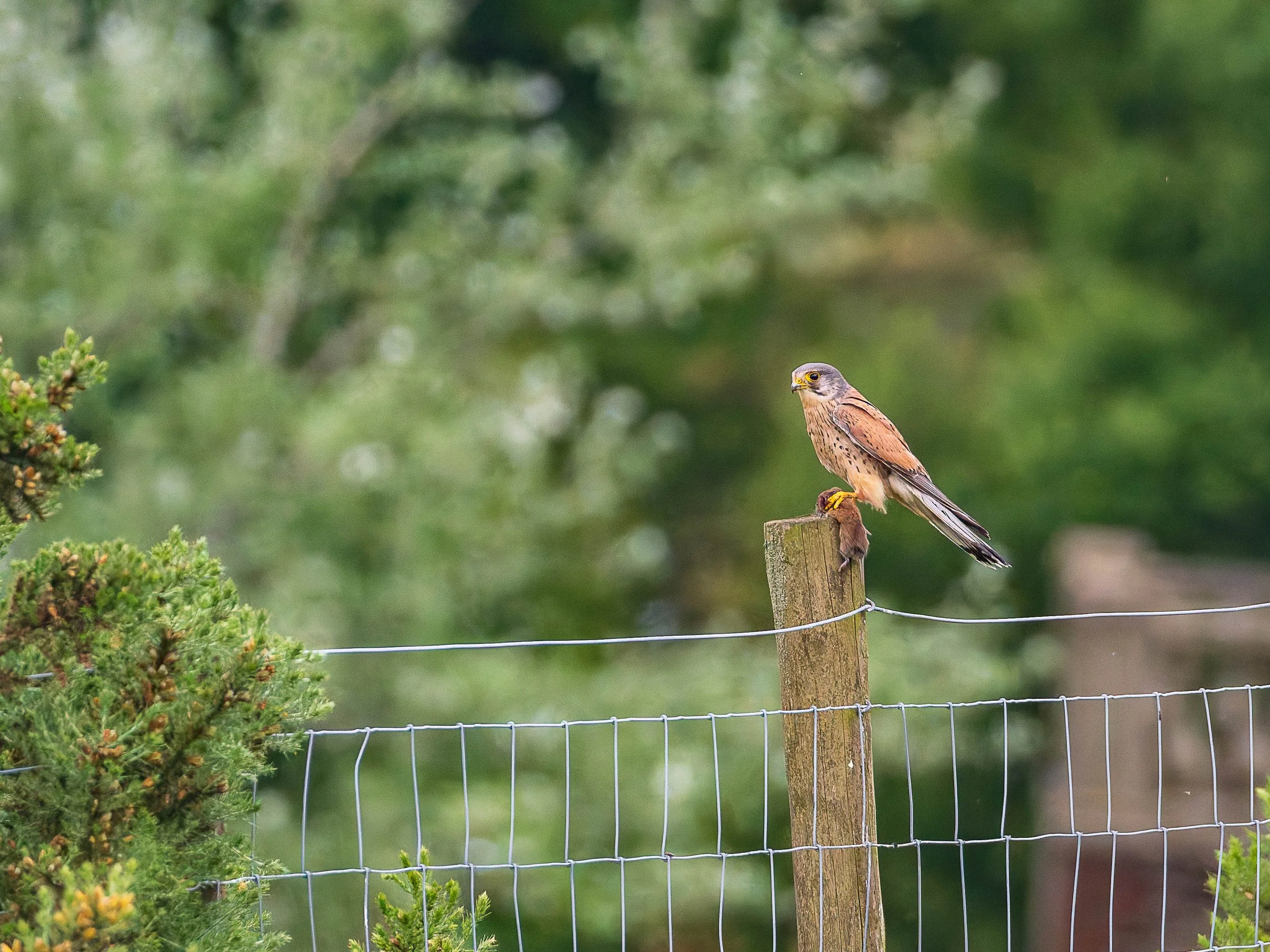
The Windhover of the Quartzite: The Kestrel’s Vigil on the Stiperstones
If the Red Grouse represents the heather-bound texture of the Stiperstones, the Common Kestrel (Falco tinnunculus) is the pure geometry of its skies. Famously dubbed the "windhover," the kestrel is a masterclass in aerodynamic stability. Even when a Force 6 gale tears across Manstone Rock or The Devil’s Chair, the kestrel can lock its head completely stationary in mid-air, suspending its body against the thermal currents to map the terrain below with absolute focus.
In the grand architecture of the 1,500-hectare expansion, this small falcon serves as a vital apex sentinel of the lowlands and the lower slopes, binding the high quartzite ridge to the sprawling fields of the Rea Valley.
Hunting the "Perfect Mess": The Mechanics of the Strike
The kestrel’s relationship with the Stiperstones habitat is entirely driven by its primary food supply: the field vole.
The Ffridd and the Flushes: Kestrels bypass the barren rock tors to hunt the ffridd—the rough, uncultivated margins where gorse, bracken, and coarse grasses merge. This "perfect mess" is prime real estate for small mammals.
Ultraviolet Tracking: The kestrel possesses a sensory superpower perfect for the wide-open heath. It can see in the ultraviolet spectrum. Because voles continually mark their run-lines through the grass with urine that reflects UV light, the hovering kestrel doesn’t just look for movement; it literally reads a glowing neon map of rodent highways crisscrossing the hillside.
The Stoop: Once a target is isolated, the hover breaks. The bird drops in a steep, controlled stage-descent, using its sharp talons to pin its prey in the thick thatch of grassland or heather.
Breeding and the Architecture of Cavities
Kestrels are cavity nesters, but they are completely devoid of carpentry skills. They do not build nests of their own.
On the Stiperstones, breeding pairs look for natural structural opportunities. They seek deep crevices in the sheer faces of the quartzite tors, hollows in ancient, wind-gnarled trees on the edge of Crows Nest Dingle, or old, abandoned stick nests built by crows and ravens. They will also readily adopt specialized nest boxes erected by conservation volunteers to bolster their breeding success.
Between April and May, the female lays a clutch of four to five speckled, chocolate-colored eggs. While she handles the bulk of the incubation, the male becomes the sole provider, relentlessly hunting the valley fringes to deliver food back to the nest cliff.
Feeding and Fledging: Life Beyond the Ledge
When the eggs hatch, the nest becomes a high-fidelity engine of demand. Both parents must join forces to hunt, tearing mice, voles, lizards, and large invertebrates into manageable pieces for the fast-growing chicks.
Out of the Nest: The Fledging Phase
At around one month old, the young kestrels take their first, clumsy leaps out of the nest cavity. At this stage, they are affectionately known as "branchers"—clinging to nearby rock edges or tree branches, covered in a scruffy mix of downy white fuzz and emerging chestnut feathers.
The Flying School: Fledging on the Stiperstones is a high-stakes masterclass in fieldcraft. The parents do not immediately stop feeding them; instead, they bring prey to nearby perches, forcing the juveniles to practice their flight mechanics to claim their meal.
The Hand-Off: In late summer, you can witness magnificent aerial "hand-offs," where an adult bird hovers over the heather and drops a vole mid-air for a screeching juvenile to clumsily catch.
Independence: Within two to four weeks of leaving the nest, the young birds learn to hover independently. By autumn, they disperse away from the family group, moving down into the lowland arable systems of Shropshire and beyond to survive their first winter.
The Shadows on the Ledger: Why the Kestrel is Amber-Listed
Despite being a classic icon of the British countryside, the kestrel is currently under a significant conservation cloud, sitting firmly on the UK Amber Warning List of Birds of Conservation Concern. The species has faced a troubling population decline—with UK numbers dropping by 37% between 1995 and 2023.
The reasons for this decline highlight the urgent need for landscape-scale projects like the 1,500-hectare expansion:
Intensive Agricultural Practices: The primary driver is the loss of foraging habitat. Modern commercial farming relies on manicured field boundaries, heavy pesticide use, and monoculture silage crops. This strips away the rough, unploughed field margins, directly crashing the populations of voles and large insects that the kestrel relies on to feed its young. They have increasingly been driven out of commercial farmland entirely.
Secondary Poisoning (Rodenticides): Kestrels are highly vulnerable to the accumulation of modern agricultural chemicals. When farmers use second-generation anticoagulant rodenticides to clear rats and mice from barns, the toxic, slow-moving rodents wander into the open. A kestrel hunting the perimeter will easily catch these compromised animals, leading to lethal or sub-lethal secondary poisoning that impacts their long-term survival and breeding capacity.
Nest Site Competition: The modern countryside features fewer old, hollow trees and derelict farm buildings. As safe nesting cavities decrease, kestrels face fierce, aggressive competition for remaining holes from highly adaptable, rising populations of cavity-dwellers like Jackdaws and Stock Doves.
The Guardian’s Frame
When capturing the kestrel with a digital telephoto kit or a medium-format camera, the image represents more than just an elegant falcon suspended against the clouds. It is a diagnostic metric for the health of the entire Shropshire ecosystem.
If the kestrel is hovering successfully over the ffridd, it proves that the Middle Marches Community Land Trust and local farmers are successfully managing the "perfect mess" below. It means the soil is alive, the voles are tunneling through the thatch, and the biological capillaries of the ridge are open. Protecting this bird isn't just about saving a single raptor; it's about ensuring the "Shropshire Squeeze" never chokes out the wild, untamed skyline of the ridge.